


Remote teams stopped being an experiment a long time ago, especially since the tough days amid COVID. For software delivery companies, it’s now simply a matter of how the best teams operate. But “going remote” and “succeeding remotely” are two very different things — and the gap between them is where most organisations quietly lose productivity, talent, and trust.
For over four years, we’ve run an entirely remote engineering company with about twenty people across Poland. We’ve delivered for demanding clients the whole time, all without an office. In this article, we’ll discuss the pros and cons of remote work and share what really makes our remote teams reliable and effective.
Some theory first: The real pros and cons of remote teams in IT
In our experience, remote work isn’t perfect or terrible. It’s a set of trade-offs that you need to manage on purpose, or you’ll end up dealing with problems by accident.
Where remote gives an advantage
Remote work gives you access to talent no matter where people live. This is the biggest advantage for a software company. Instead of hiring only from one city, you can find the best engineer for the job, wherever they are. For specialised roles such as senior platform engineers or niche experts, this can mean filling a position quickly rather than leaving it open for months.
Remote work makes it easier to protect deep focus. Engineering needs long, uninterrupted time to concentrate. When remote teams use mostly non-simultaneous communication, it’s much easier to stay focused than in an open office where people interrupt each other.
Remote work means lower overhead costs. Going remote completely wipes out office overhead—no rent, no commuting stipends, and zero relocation costs. When you handle this right, that extra cash goes straight back to the team through better salaries, top-tier hardware, and serious learning budgets. It’s a win-win.
Remote teams have to document their decisions because they can’t rely on quick hallway chats. Over time, this forms a shared memory for the team, something that in-person teams often don’t have.
Where remote can really hurt
Communication in remote teams needs to be planned, not just assumed. In an office, a lot of coordination happens naturally. Remotely, if you don’t set up clear ways to communicate, it just won’t happen. Silence can mean many things—someone might be focused, stuck, or disconnected. You can’t know just by looking at their Slack status.
Onboarding is more challenging remotely. New hires can’t pick up context just by being around others. Without a clear onboarding process, a new engineer might spend weeks feeling lost and reluctant to ask what seem like obvious questions.
Remote work’s flexibility may blur the line between work and private life. This can result in isolation and burnout, which often go unnoticed because people aren’t visibly struggling at their desks.
Remote work can create anxiety about trust and visibility. Managers who think being present means being productive may turn to surveillance, which hurts morale. On the other hand, engineers might feel invisible and unsure if their work is noticed or valued.
The main pattern is that remote work bolsters your existing management habits. Good processes improve, while weak ones fall apart even faster.
How remote teams fail: Lessons from the literature and the industry
You don’t have to make these mistakes yourself. Many organisations have already experienced and documented them.
One common mistake is treating remote work as just office work done at home. Many sources on remote work point out that copying in-office habits over video—like consecutive meetings, expecting instant replies, and always keeping the camera on—brings the worst parts of office life without the benefits. Successful remote companies, like GitLab (see their public handbook), make asynchronous, written communication the norm and use live meetings only when needed.
Remote teams often experience communication overload that masquerades as collaboration. Research shows that meetings and messages increase when teams go remote without changing their processes. This leads to ‘always on’ fatigue, where people are always available but not very productive. Microsoft’s research on remote work found that, without changes, teams become more siloed and communication gets more fragmented over time.
Some companies rely on surveillance rather than nurturing trust. They resort to “productivity trackers”—things like keystroke loggers and automated screenshot apps. But tracking clicks doesn’t measure real engineering value; it just breeds resentment. If you treat your developers like untrustworthy assembly-line workers, your highest performers will be the very first to walk out the door.
This is not rocket science: when a team member’s conversations are only job-related, relationships remain shallow and boring. If you don’t intentionally build social places into your work-from-home communication, people can become isolated and may lose trust, interest, engagement and more. In fact, a recent global study confirmed exactly what we know from practice: skipping out on the human side of remote work directly fractures project collaboration and leaves developers feeling lonely (Nguyen-Duc et al., 2024).
Some organisations try to use their informal, in-person onboarding for remote teams without changing it. As a result, new hires take much longer to become productive and often leave early. Not having a written onboarding process is especially hard on newcomers (Rodeghero et al., 2021).
The main point is that these failures aren’t really about technology. They’re focused on leaders, not redesigning how work gets done and simply putting the old way online.
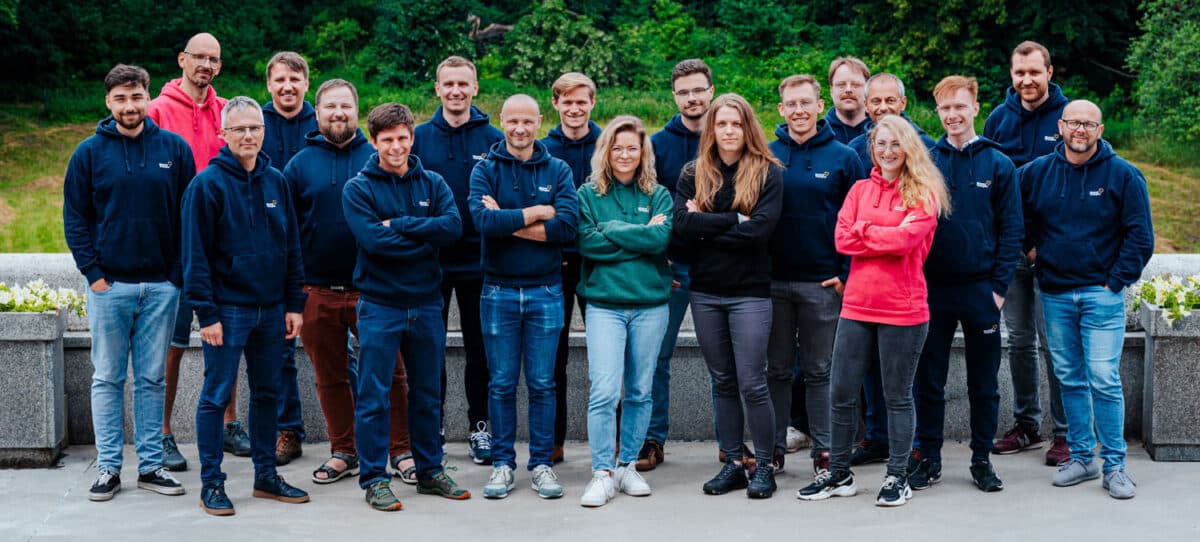
Shaped Thoughts case study: Our proven practices for remote software teams
Here are some of our proven practices, thanks to which we have been working entirely remotely for years:
Communication norms
In ShapedThoughts, we prefer non-simultaneous communication via dedicated thematic channels on Slack. We practise low-context communication. This means that messages should contain all the information necessary for co-workers to understand the issue, make decisions, or take action without requiring extra clarification. This includes providing sufficient background, links, screenshots, and clearly stating expectations or following steps.
Furthermore, we ensure team members regularly share progress, blockers, and achievements, delivering transparency across projects and teams.
We have defined communication guidelines that describe not only how to communicate effectively in a remote environment, but also which communication tactics to avoid. For example, we use a simple status system to communicate availability, breaks, or focus time, helping everyone collaborate without needless interruptions.
We also keep cameras on because it’s nice to see a human face. This also helps us build a stronger connection.
Besides day-to-day collaboration, we organise regular one-to-one meetings, team meetings, founders meetings, retrospectives, and company-wide weekly updates to discuss ongoing work, exchange feedback, coordinate priorities, and share important information.
Documentation & knowledge sharing
In Shaped Thoughts, we strongly believe that undocumented knowledge is lost knowledge. We capture architectural decisions using ADRs, keep project documentation close to the code whenever possible, and share important technical discussions with the team. We also treat documentation as part of the engineering process, not an afterthought. This ensures that all project members can understand the system context, design rationale, and previous decisions without relying on tribal knowledge.
General organisational knowledge is stored in centrally accessible repositories. In Shaped Thoughts, we prefer Slack, Google Docs, and Confluence. In contrast, technical and API-related knowledge is documented and shared via tools such as Bruno (formerly Postman), empowering engineers to understand and work with existing services quickly.
Onboarding
New engineers are introduced to the company through a structured, largely automated process. From day one, they have access to an onboarding platform that includes an organisation map, descriptions of key processes, technical documentation, and clear step-by-step guidelines for setting up their environment and starting to contribute. Our goal is to enable every new team member to complete their first task—even a simple one—on their very first day.
What’s more, we assign each newcomer to a dedicated buddy who supports them during their first weeks, helping them navigate challenges, understand team practices, and become productive quickly.
Large codebases and system architecture are hard to convey in one go, as it takes time to explore and learn them. This is why, from day one, every newcomer is also accompanied by an AI buddy, Claude. Structured project knowledge encapsulated by our internal CLI tooling makes Claude Code a very powerful virtual teammate who literally can explain anything about the project.
Trust & accountability
We do not measure online presence or the number of lines of code. We value the quality of the code and work delivered, team communication, and active participation in planned work. Team members are trusted to organise their work independently, in line with the practices agreed within their teams.
In Shaped Thoughts, we do not track working hours (however, we need them for financial purposes). Instead, teams define a limited set of core hours during which everyone is expected to be available for collaboration. Outside those hours, engineers are free to structure their day however works best for them. Of course, as long as it still lines up with what the team needs.
Group unity
We really appreciate the support team members show each other, such as mutual code reviews or help with technical problems. We use Slack to celebrate wins, give each other public shout-outs, and make sure sharing knowledge feels like everyone’s job, not just one person’s. This really motivates, builds bonds, shows that there is strength in the group, and that each member can count on the support of the rest of the team.
Furthermore, we strongly promote a culture of “continuous feedback”. That is why we encourage all team members to provide it regularly rather than waiting for formal review cycles. We introduce this approach already at the recruitment stage. You can read more about our perspective on giving constructive feedback here.
Regular team meetings and informal online gatherings help us maintain strong relationships despite working remotely. In addition, we organise company off-sites several times a year to strengthen relationships and spend time together outside our daily online interactions.


Tooling
We rely on modern collaboration and development tools that support internal communication, process automation, project management, source control, and observability. Tools such as Slack, GitHub, Bruno, CI/CD platforms, Claude Code, Pop, and monitoring systems form the backbone of our remote engineering environment. By automating recurring tasks and preserving a consistent development workflow, we enable engineers to focus on solving problems and adding value rather than managing operational burden.
Summary: What makes remote software teams succeed
Remote work benefits intentional teams and harms those that just drift along. We really know it from practise: the teams that succeed aren’t the ones with the fanciest tools or strictest rules. They’re the ones that clearly decide how to communicate, build trust, and support their people. And then stick to those choices. After four years, we’ve learned that it was never the office that held a team together—it was the practices.
Frequently asked questions
How do you keep remote engineering teams aligned without constant meetings? By defaulting to asynchronous, written communication in dedicated channels and reserving live meetings for when they’re really needed. Clear, low-context messages—with all the background, links, and follow-up steps included—let people stay coordinated without being “always on.”
How do you measure productivity in a remote software team? Not by monitoring hours, online presence, or lines of code. We focus on 3 main areas:
- the quality of work delivered,
- the strength of team communication,
- active participation in planned work, trusting engineers to organise their own time around a small set of shared core hours.
What’s the hardest part of running an entirely remote software company? Onboarding and social connection. Both have to be deliberately designed through structured onboarding, a dedicated buddy for every newcomer, continuous feedback, and regular off-sites. In remote companies, neither happens automatically the way it can in an office.
References
Nguyen-Duc A., Khanna D., Huong Le G., Greer D., Wang X., Martinez Zaina L., Matturro G., Melegati J., Guerra E., Kettunen P., Hyrynsalmi S., Edison H., Sales A., Chanin R., Rutitis D., Kemell K.-K., Aldaeej A., Mikkonen T., Garbajosa J., Abrahamsson P., 2024, Work-from-home impacts on software project: A global study on software development practices and stakeholder perceptions, Software: Practice and Experience, 54(5), 896–926. https://doi.org/10.1002/spe.3306
Rodeghero P., Zimmermann T., Houck B., Ford D., 2021, Please turn your cameras on: Remote onboarding of software developers during a pandemic, in: Proceedings of the IEEE/ACM 43rd International Conference on Software Engineering: Software Engineering in Practice (ICSE-SEIP), 41–50. https://doi.org/10.1109/ICSE-SEIP52600.2021.00013

