


Global businesses are experiencing a fundamental shift in how they approach IT development outsourcing. Companies strategically transfer business activities to other countries through captive offshoring (establishing owned subsidiaries abroad) or offshore outsourcing (contracting with external providers).
Why does offshoring make business sense? Mainly to cut costs, leverage foreign talent and available infrastructure, but also to be closer to new markets. While the economies of receiving countries benefit from this (like India, where JP Morgan and Tata develop IT centers), it creates heated debates about job losses in home countries (e.g., USA). Despite challenges – such as skepticism toward globalization after the pandemic or supply chain disruption risks – offshoring continues to gain popularity. On the contrary, companies still see tremendous value in it, especially in the era of remote work and demand for specialized expertise (e.g., in AI or cybersecurity), making it a permanent and dynamically evolving element of global business environment.
- Offshoring vs. Nearshoring: Key Differences and Business Impact
- Offshore Outsourcing vs Nearshore Outsourcing: What’s the Difference?
- What Are the Key Risks in Offshore vs Nearshore Outsourcing?
- Why is This Important Today?
- Poland: A Leading Hub for Offshore and Nearshore IT Services
- Key Criteria for Selecting a Country for IT Offshoring
- Offshoring and Nearshoring as a Strategy for the Future
Offshoring vs. Nearshoring: Key Differences and Business Impact
Offshoring represents a business strategy where companies transfer IT development outsourcing activities to geographically distant countries. This approach typically involves either establishing captive centers or engaging in offshore it outsourcing partnerships with external providers. Companies pursue this strategy primarily to achieve low cost operations, leverage specialized talent pools, and access robust technological infrastructure.
Nearshoring, on the other hand, focuses on outsourcing IT development to neighboring countries (nearshore locations) or regions with similar time zones and cultural alignment. This nearshore outsourcing approach offers a balanced solution that maintains operational efficiencies while reducing the complexities associated with distant offshore locations. Companies choose nearshore outsourcing to reduce the risk of language barriers, facilitate operational control and shorten response times, while maintaining some cost savings. This is particularly attractive during global crises, where geographical proximity reduces supply chain disruption risks.
Offshore Outsourcing vs Nearshore Outsourcing: What’s the Difference?
| Criteria | Offshoring | Nearshoring |
|---|---|---|
| Location | Geographically distant countries (e.g., USA → India, Germany → Vietnam) | Geographically close countries (e.g., USA → Mexico, Germany → Poland) |
| Economic Cost | Significantly lower labor costs, but higher logistics/control costs | Moderately lower labor costs, but lower management costs |
| Time Differences | Large (e.g., 9–12 hours), hampers real-time communication | Small (0–3 hours), facilitates synchronous collaboration |
| Cultural Barriers | High – require intensive management of differences | Low/moderate – cultural similarity reduces conflicts |
| Operational Risk | Higher (long supply chains, political risk) | Lower (shorter routes, more stable relationships) |
| Examples | IT support in India, electronics manufacturing in China | Call centers in Poland for Germany, car assembly in Mexico for USA |
What Are the Key Risks in Offshore vs Nearshore Outsourcing?
Choosing between offshore and nearshore outsourcing is not just about costs or access to talent—it also involves carefully balancing associated risks. Academic research highlights several critical risk factors that companies must consider when selecting their global sourcing strategy.
Communication challenges are more pronounced in offshore outsourcing. Due to large time zone differences and language barriers, teams may face miscommunication, project delays, and misunderstandings that impact quality and delivery (Kedia & Lahiri, 2007). Nearshore outsourcing benefits from closer time zones and often greater cultural and linguistic affinity, reducing these risks and enabling more seamless communication (Manning, Massini, & Lewin, 2008).
Control and coordination risks also vary significantly. Managing teams across vast distances in offshore setups complicates supervision and slows decision-making (Levina & Ross, 2003). In contrast, nearshoring leverages geographic proximity, which allows for easier coordination, more frequent in-person meetings, and quicker problem resolution (Jensen & Pedersen, 2011).
Cultural differences present another layer of risk in offshore models. Differences in business practices, work ethics, and organizational cultures can hinder collaboration and trust-building (Hofstede, 2001). Nearshore partnerships often enjoy stronger cultural alignment, facilitating smoother integration and long-term relationships.
Lastly, legal and regulatory risks tend to be higher offshore due to unfamiliar or divergent frameworks regarding data protection, intellectual property, and compliance (Carmel & Tjia, 2005). Nearshore arrangements generally benefit from more similar legal environments, reducing uncertainty and compliance complexity.
In summary, while offshore outsourcing offers cost advantages and access to vast talent pools, it carries increased risks in communication, coordination, cultural alignment, and legal compliance. Nearshoring, though sometimes costlier, reduces these risks thanks to proximity and cultural similarities. Understanding and weighing these trade-offs is crucial for companies aiming to optimize their outsourcing strategies.
| Key Risk | Offshore Outsourcing | Nearshore Outsourcing |
|---|---|---|
| Communication | High (large time zones, language barriers) | Low (similar time zones, cultural affinity) |
| Control & Coordination | Difficult (distance, limited oversight) | Easier (geographic proximity, frequent interaction) |
| Cultural Differences | Significant (different norms, values) | Lower (shared cultural context) |
| Legal & Regulatory | Complex (unfamiliar laws, compliance risks) | More aligned (similar legal systems) |
Why is This Important Today?
Nearshoring is experiencing a renaissance due to the pandemic and geopolitical conflicts – companies are seeking safe proximity. Offshoring still dominates in scalable projects (e.g., software development), but nearshoring wins where speed and quality of collaboration matter.
The choice? It depends on priorities: lower cost (offshoring) vs. lower risk (nearshoring).
Poland: A Leading Hub for Offshore and Nearshore IT Services
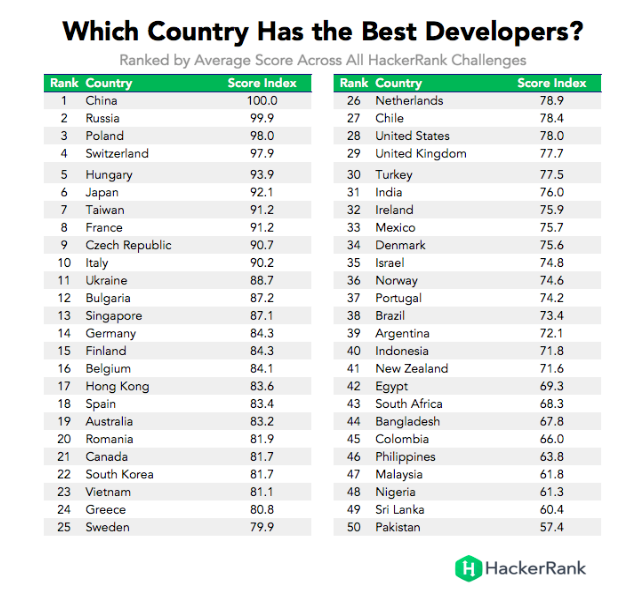
Poland is a global powerhouse in offshore and nearshore IT services. While other locations compete for a spot in the top twenty of the HackerRank ranking, Polish programmers occupy an impressive 3rd place worldwide (98 points), ahead of the USA (79.8) and Germany (84.3).
With 295,000 active IT specialists – more than Turkey (150k) and the Philippines (199k) combined – and 44,000 technical graduates annually, Poland offers the largest talent pool in Central Europe and high quality. Polish developers dominate in 5 out of 15 technological categories in HackerRank – including #1 in Java, #2 in Python. (No wonder that one of OpenAI’s co-founders is a Polish programmer, Wojciech Zaremba)
The advantage also includes strategic location (no time barriers for Europe and the West), strong innovation culture (70% of programmers start their coding journey between the ages of 5-10!), and the ICT service provider sector already accounts for 8% of Polish GDP. No wonder global brands like Google, Intel, and Cisco locate their R&D centers here.
It’s not without reason that Emerging Europe calls us “the most competitive IT location in the region.” Poland is simply the safest choice for companies that don’t want to choose between costs and world-class quality.
Key Criteria for Selecting a Country for IT Offshoring
1. Quality and Availability of Talents
Technical Education Level: Check how developed the IT education system is in a given country. The number of technical graduates, reputation of higher education institutions (e.g., polytechnics), certification programs and specialized training are crucial for candidate quality. The more advanced and practical the training, the faster new employees adapt to real project requirements.
Global Rankings and Programming Competitions: Results in rankings such as HackerRank, TopCoder, or Google Code Jam show how a country performs in terms of programming competencies compared to other nations. The higher the position, the greater the chance of finding world-class experts.
Technological Specializations: It’s worth verifying whether a given country has strengths in technologies that are key to your project. Some countries are leaders in specific programming languages, frameworks, or areas (e.g., AI, Big Data, embedded, blockchain). This significantly affects the pace and quality of implementation.
2. Razor-Sharp Economic Cost Considerations
Employment Costs: Developer salaries are obviously the main cost, but remember other expenses: taxes, social insurance contributions, recruitment costs, training, benefits, and turnover (frequent turnover means additional costs and risks).
Cost-Quality Ratio: The cheapest worker isn’t always the best investment. Poor code quality, communication problems, or long implementation times can generate higher hidden costs. It’s worth comparing not just price but team efficiency.
Indirect Costs: Include in your budget, for example, offshoring management costs, supervision needs, delay risks, or correction requirements. All this affects the total project cost.
3. Mission-Critical Operational Factors: Time Zone and Location
Work Synchronization: Proximity of time zones enables effective real-time collaboration, which speeds up problem-solving and decision-making. For European companies, it’s important that the offshore team operates during similar working hours.
Transportation and Travel Availability: Ease and cost of traveling to the location (e.g., to company headquarters) affects visit frequency and project control—shorter flight times and good infrastructure support better collaboration.
Culture and Language: Cultural similarity facilitates understanding and minimizes the risk of misunderstanding. The level of English proficiency (or other working language) is the foundation of effective communication.
4. Fortress-Like Business Environment Stability and Security
Political and Economic Stability: Countries with stable legal and political systems mean lower risk of sudden regulatory changes that could hamper business operations. Economic stability affects continuous access to talent and cost maintenance.
Data Security and Intellectual Property Protection: Verify local laws regarding data protection and intellectual property, as well as business practices in securing information. This is critical when working with sensitive projects.
Membership in International Organizations: Membership in the EU, NATO, or other organizations affects trust levels and compliance with global security standards.
5. Electrifying Technology Ecosystem
Presence of Global Companies and R&D Centers: The presence of giants like Google, Intel, Microsoft, or Cisco demonstrates market maturity, expert availability, and high work standards.
Startups, Investments, and Innovation: A dynamic startup ecosystem and access to venture capital funds indicate that a country not only develops technologically but also quickly adapts new trends and work methodologies.
IT Infrastructure: Fast internet, modern offices, access to tools and remote work platforms are basics that guarantee smooth team operation.
6. Offshoring Experience
History of Offshore Project Implementation: Countries with rich experience have developed cooperation standards and know how to deal with typical challenges.
Communication and Organizational Maturity: Knowledge of agile methodologies, DevOps, experience in working in distributed teams is a huge advantage. The more mature the team, the fewer management problems.
Scalability and Flexibility: The ability to quickly expand the team or change the scope of cooperation is important with dynamically changing business needs.

Offshoring and Nearshoring as a Strategy for the Future
In today’s competitive business environment, companies are increasingly turning to offshore and nearshore outsourcing strategies to enhance operational efficiencies while managing rising costs. The decision to outsource IT services has evolved from a simple cost-cutting measure to a sophisticated approach for accessing global talent and achieving sustainable growth.
The key to success is not choosing between offshoring and nearshoring, but consciously matching the business strategy to business specifics. Projects requiring close collaboration and quick response will find their place in nearshoring, while scalable, long-term initiatives can successfully use offshoring. The wisest companies build hybrid business models, combining the advantages of both approaches.
Poland, as a perfect example, shows that you can be both cost-competitive and world-class in terms of quality. It’s precisely such countries – offering stability, talent, and technological maturity – that will shape the future of global IT outsourcing.
In the era of artificial intelligence, automation, and remote work, offshoring and nearshoring won’t disappear – they will evolve. Companies that invest today in building international teams and perfecting remote collaboration processes will be tomorrow’s market leaders. The question isn’t “is it worth it?” but “how to do it best?”

