
Connecting Telematics Data
to Your Insurance Systems
Adding telematics to an insurance product introduces a new stream of vehicle and driver data into the existing technology stack.
Location, speed, acceleration, braking, mileage and other events may arrive continuously or in batches. They need to be collected, processed and passed to the systems that use them. A policy administration or claims system, for example, may only need selected events rather than the full telemetry stream.
The data itself can come from many places: connected vehicles, OEM platforms, OBD-II devices, mobile apps and third-party telematics providers. Formats, payloads and delivery methods vary between sources.
You don’t have to put all of that processing into your core insurance platform.
At Shaped Thoughts, we build the data and processing infrastructure between telematics sources and your existing insurance platform. We can ingest events from devices, mobile apps, OEM platforms, or third-party providers, process and transform the data, and expose the results through APIs or event-based integrations.
This keeps high-volume telematics processing separate from core insurance systems while letting you add telematics to an existing product.
Telematics Data Architecture
Telematics data sits between connected vehicles and the insurance systems that need to use it. A separate ingestion and processing layer can handle the incoming vehicle data before passing relevant information to pricing, underwriting, policy, and claims workflows.
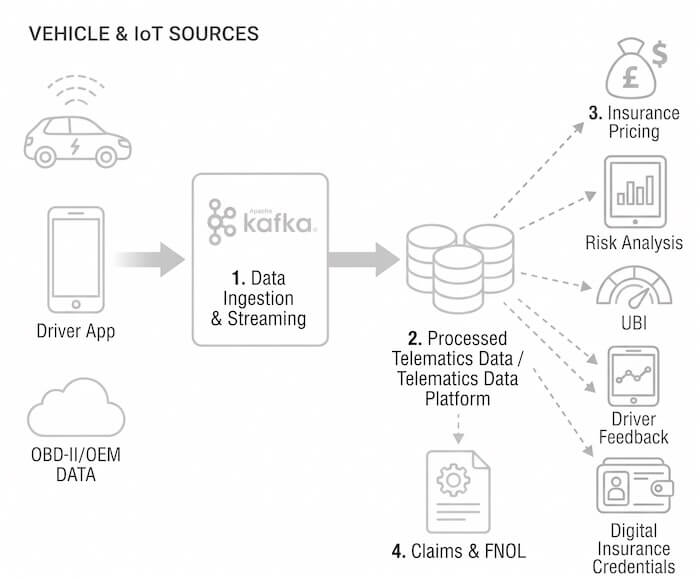

Insurance Telematics & Connected Data Engineering
Real-Time Telematics Data Pipelines
Vehicle and device data can arrive continuously, generating large numbers of events that need to be collected and processed as they come in. We build streaming pipelines that handle high-volume telemetry and event-driven workloads.
Technologies: Apache Kafka, AWS Kinesis, event-driven architecture, serverless services, reactive microservices.
Connected Insurance Applications
Telematics data can also be exposed directly to drivers through mobile applications and digital insurance services. We build the application components needed to display vehicle data, provide feedback and support digital insurance credentials.
Capabilities: Mobile SDKs, Apple Wallet and Google Wallet, driver dashboards, digital policy passes.
Telematics Data Processing & Analysis
Raw telemetry needs to be cleaned, transformed and enriched before other parts of the insurance platform can use it. We process vehicle data for driving behaviour, mileage and trip analysis, risk assessment, UBI, pricing, underwriting and claims.
Capabilities: Driver behaviour analysis, mileage and driving metrics, contextual data enrichment, UBI integration, risk-scoring services.
Insurance Platform Integration
We move processed telematics data to the applications that use it, from rating and underwriting to policy administration and claims. We connect these systems through APIs, events and data transformation, including integrations with older platforms.
Capabilities: REST and gRPC APIs, legacy integrations, data transformation, event connectors, distributed data architectures.
When You Need Telematics Engineering
You may already have a telematics provider and a core insurance platform. The missing piece is often the software between them.
- Launching a UBI product — connect vehicle or driver data to pricing and policy workflows.
- Adding telematics to an existing product — introduce a separate data layer without changing the core insurance platform.
- Working with multiple data sources — ingest data from OEMs, OBD-II devices, mobile apps, or third-party providers.
- Connecting telematics to insurance workflows — pass processed data into pricing, underwriting, policy, or claims systems.
- Handling growing telemetry volumes — move high-volume event processing outside systems that were not designed for continuous vehicle data.
More on Telematics in Insurance
Want to explore the technology behind connected insurance?
Case Study: Building a Scalable Insurance Data Architecture
A growing InsurTech company needed to manage large, complex datasets across its platform. Its centralised data setup was difficult to scale and created pressure on services handling high volumes of data.
Shaped Thoughts redesigned the architecture using Data Mesh principles and Domain-Driven Design, giving individual business domains ownership of their data and introducing scalable pipelines for downstream applications and models.
The new architecture provided:
- Better scalability as data volumes increased
- Less pressure on core administration services
- Clearer ownership of data
- Stronger controls around data quality, security, and governance
- Data that could be accessed in near real time by downstream applications
FAQ
Do you need to connect telematics data to your insurance systems?
Reach out to our engineering team to discuss your UBI product, connected-vehicle data, risk-scoring needs, or legacy integration challenges.